I just finished the first of my last 10 days at Shonai Chuu. This is my most difficult school, and I remember having some real difficult times the previous two rounds I was there last year. When I was there in December, I wrote that one of the English teachers would be leaving, and a new one would be starting there in January. I met the new teacher today, and his name is Yamanaka sensei.
One of the biggest issues I had with my previous times at Shonai Chuu was working with the English teacher of the older kids, san-nensei. I realized today how true that really was. At the risk of speaking too soon and/or jinxing myself, I'd say that Yamanaka sensei and the previous teacher, Deguchi sensei, are in many ways direct opposites. I can remember a few times last year having to play a human tape recorder for students in a classroom that was almost too loud to hear myself speak in. Today I had three classes with the san-nensei students and every class was kept relatively quiet and wholly in control by Yamanaka sensei. I am not looking to figure out why these teachers were so different in the classroom; my point is only that they are and it makes all the difference in the world. I had one of the best days of teaching I can remember in a very long time, and I hardly did anything as a teacher worth talking about.
In fact, I was a human tape recorder today, and I didn't mind it a bit. I read sentences for the students in my best American English so they could try to understand me and answer a few questions. I probably sounded like a voice on one of the audio cd's that accompany the textbook, except with a little more nasal tone (I am getting over a cold). I did do other things, and really enjoyed helping the students with their writing section of the review test. But, I have to say I felt really good about doing what I was doing in large part because Yamanaka sensei acknowledged the spot he was putting me in. Before the classes, he gave me a short head nod, or tiny bow, and said 'I'm sorry for using you as a tape recorder.' That really helped.
I saw students working hard on a review test today that probably wouldn't have bothered a few months ago. These same students listened to me and Yamanaka sensei today when their norm a couple of months ago was to talk to each other while consciously not listening to the teacher(s).
In a few weeks time all the san-nensei students will be taking their entrance examinations to get into high school, so I'm hoping the hard work keeps up till then and pays off. I've heard of high schools here full of students that don't pass their entrance exams; from these places it is much, much harder for students to then go on to university.
Shonai is the poorest of the four junior high schools I work at. The city of Shonai looks generally poorer and more rural than Iizuka city. Academically, it is no doubt one of the worst in the area. Matter of fact, I also work at the most academic junior high school in the area, Ichuu. Ichuu has many students from the wealthiest and more well-off families in the area. Many students at Ichuu attend private academic lessons afterschool, or 'cramschools' called Juku. A teacher told me that it costs families $200-400 a month to send their kids to Juku. As for students that don't have such opportunities, they must rely more on good teaching and personal effort to get ahead.
Monday, February 23, 2009


Sunday, February 15, 2009
Bridge Opening in Iizuka
Hey y'all, last weekend I went to a ceremonial bridge opening in Iizuka, about a 10 minute walk from my apartment. Since I've been here they've been doing a lot of construction around town - fixing sidewalks and roads, building this bridge, and moving a bunch of earth near the river that cuts through the city. Anyway, this bridge opening turned out to be a big deal for this town, and the turnout was kind of mighty (for Iizuka). I'm really happy one of my co-teachers told me about it, because the interesting dances and music were totally unexpected. Who would have thought such a display of Japanese culture could be present so close to my house at 10am on a Saturday?
I took some short videos of some of the dances that were performed. I especially enjoyed the last one performed, where older Japanese ladies dressed in fancy kimonos were cutting a rug on the bridge. The sight of these ladies reminded me of my grandma, Yoshiko - though I'm sure she'd rather be indoors watching sumo on TV and eating macaroni salad than be outside dancing in the streets like this...
I took some short videos of some of the dances that were performed. I especially enjoyed the last one performed, where older Japanese ladies dressed in fancy kimonos were cutting a rug on the bridge. The sight of these ladies reminded me of my grandma, Yoshiko - though I'm sure she'd rather be indoors watching sumo on TV and eating macaroni salad than be outside dancing in the streets like this...
Thursday, February 5, 2009
Iizuka and Dazaifu
These are some photos of the weekend I spent last month with Elizabeth. We spent one day checking out Iizuka and a day in Fukuoka city and Dazaifu, a small historic town known for its temples.
 Elizabeth and I on the train from Fukuoka city heading to Iizuka.
 A temple very near my apartment in Iizuka.
 A famous Shinto temple in Dazaifu city. When were there it was unusually crowded. This is the same temple I visited last October when Koki and Kazue came to see me from Tokyo.
 Some Japanese koi in the foreground and fortunes on pink sheets of paper in the background. I just now read on wikipedia that 'koi breeding' originated in Japan in the 18th century. The red and white colored ones here (kohaku) are a product of this breeding. I love that website.
 A crowd of people lined up to pay their respects at the temple shrine. There were a few priests doing some rituals for those praying at this moment.
 Bamboo (take) trees near the temple. We were both interested to see such tall bamboo chutes.
 The gate to the temple. Beyond this gate is a narrow road with lots of food and souvenir shops on either side. It was pretty crowded this day. As a sidenote, this temple was one of the most populated spots in Japan on New Year's day (this is what the news said around midnight when I was in Tokyo).
 Me buying some Japanese treats filled with sweet bean paste (anko).
 Elizabeth and I on the train from Fukuoka city heading to Iizuka.
 A temple very near my apartment in Iizuka.
 A famous Shinto temple in Dazaifu city. When were there it was unusually crowded. This is the same temple I visited last October when Koki and Kazue came to see me from Tokyo.
 Some Japanese koi in the foreground and fortunes on pink sheets of paper in the background. I just now read on wikipedia that 'koi breeding' originated in Japan in the 18th century. The red and white colored ones here (kohaku) are a product of this breeding. I love that website.
 A crowd of people lined up to pay their respects at the temple shrine. There were a few priests doing some rituals for those praying at this moment.
 Bamboo (take) trees near the temple. We were both interested to see such tall bamboo chutes.
 The gate to the temple. Beyond this gate is a narrow road with lots of food and souvenir shops on either side. It was pretty crowded this day. As a sidenote, this temple was one of the most populated spots in Japan on New Year's day (this is what the news said around midnight when I was in Tokyo).
  Me buying some Japanese treats filled with sweet bean paste (anko).
Monday, January 26, 2009
Just a little bit of art
Hey everyone, I just realized that I have some good pictures to post from two weekends ago when my girlfriend Elizabeth came to visit me from Korea, but I don't have time to post them now. I'll post them soon. These scarce pictures are of some artwork I've done (really all of the artwork) since I've been in Japan. The first ones are cartoons I was asked to draw last week by an English teacher at my first junior high school, Ichuu. The older students (san-nensei), who are moving on to high school soon, are preparing to take their entrance examinations and the English teacher wanted me to draw some good luck pictures for them. She said she would make them into stickers for the students. The second batch of pictures are of some Japanese calligraphy I did while staying at Koki and Kazue's house in Tokyo over winter vacation. Koki taught me how to write a couple Kanji (Chinese characters) and did a few of his own. We each drew some pictures beneath them to remember their meaning.


 Koki helping me write my first Kanji in calligraphy...
 I asked Koki to to teach me the Kanji for 'delicious Tuna.' The top part means 'tuna' and the bottom part, read from the right and down, then the left and down, means 'beautiful taste.' It really fascinated me to find out that Japanese people actually describe tastes as having beauty, and also that I had been using the word that represents these Kanji (oishii) super loosely up to then. I realize now that many of my school lunches didn't deserve that title, even if I said they were only sukoshi oishii (having a little bit of a beautiful taste).
 This Kanji, called 'aji,' means 'to taste.' My cartoon makes it look like the Kanji means 'burn your tongue on a cheeseburger...' Anyway I think my cheeseburger looks way better than my Kanji.
 Koki, the true Japanese artist, with his Kanji. The one on the left is 'Tuna' (maguro) and the one on the right is cow (ushi). And 2009 is the year of the cow.


 Koki helping me write my first Kanji in calligraphy...
 I asked Koki to to teach me the Kanji for 'delicious Tuna.' The top part means 'tuna' and the bottom part, read from the right and down, then the left and down, means 'beautiful taste.' It really fascinated me to find out that Japanese people actually describe tastes as having beauty, and also that I had been using the word that represents these Kanji (oishii) super loosely up to then. I realize now that many of my school lunches didn't deserve that title, even if I said they were only sukoshi oishii (having a little bit of a beautiful taste).
 This Kanji, called 'aji,' means 'to taste.' My cartoon makes it look like the Kanji means 'burn your tongue on a cheeseburger...' Anyway I think my cheeseburger looks way better than my Kanji.
 Koki, the true Japanese artist, with his Kanji. The one on the left is 'Tuna' (maguro) and the one on the right is cow (ushi). And 2009 is the year of the cow.
Thursday, January 8, 2009
My winter vacation
Hey everyone, these are photos of my recent trip to Tokyo, Saitama prefecture, and a ski resort called Manza in a neighboring prefecture called Gunma. In Tokyo, I stayed with Koki and Kazue, who are my grandmother's cousin's son and wife. They hosted me the entire trip, and I stayed at their place in Tokyo from Christmas day until New Year's day. On New Year's Day we traveled to Saitama prefecture to meet up with Koki's father, Seiichan, and some other family members. After spending a night in Saitama (and a pretty cold one at that in Seiichan's old house - I woke up and my face was freezing) - everyone crammed into two cars and drove to Manza ski resort in Gunma prefecture. It took about 2 hours to get to the resort from Seiichan's house in Honjo city, Saitama. Also, it was about a 6 and a half hour train ride (via bullet train, or Shinkansen) from Fukuoka city to Tokyo.
 Tokyo from a tall building in Shinjuku, the area with Japan's federal buildings. When I arrived in Tokyo neither Koki, Kazue or I had planned anything to do from Christmas day to New Year's. So the day after Christmas, while Koki and Kazue had their final day of work, I traveled to this tall building (called Tocho) where they have a lot of tourism information on Tokyo. It was funny arriving in Tokyo and realizing it would be a good idea to look for worthwhile things to do the week I was there.
 Fish flags flying outside Tokyo Sea Life Aquarium, an awesome aquarium in an oceanside area called Kasai. The weather the entire week was really clear and a little windy, and much, much warmer than the winter vacation days I remember in Oregon.
 Kazue at Ueno Park Zoo. Koki, Kazue and I were really excited to see their pandas, but the big black and white one they had actually died a few months earlier. The only ones we saw were red and black ones, which were small and barely looked like bears. We were a little disappointed.
 A picture taken at Yoyogi park during a weekly flea market. This area of Tokyo was really neat to see because of all the hipsters and funny people that hang out there. Some of the people I saw reminded me of characters you would see at Venice Beach in Los Angeles. One guy was wearing a bright green joggers suit with reflectors all over him and some giant headphones as he cruised around the park on his bike...
 Koki and I taking a tour of the American and Japanese naval bases at Yokosuka, a famous port city in Yokohama Bay. The ships we saw were long and big (both the American and Japanese). This well know spot is the port where the American Commodore Perry came in the 19th century with big black battleships to essentially force Japan to open up to trade after having about 250 years of isolation. Oddly, I saw Perry's face sort of commemorated on the city's man-hole covers, as well as 'Instant Perry Curry' which you could buy as a souvenir.
 As a more personal anecdote, this is also the spot where my Japanese grandmother met my American grandfather, who had enlisted with the marines when they met in the 1950's.
 Yokohama city.
 Yokohama was really interesting to me in part because of all the Western style buildings and Christian churches we saw. This church is in an old area of town where there are primarily Western, older style houses and churches. I also liked Yokohama because it was very easy to walk around and see a great deal.
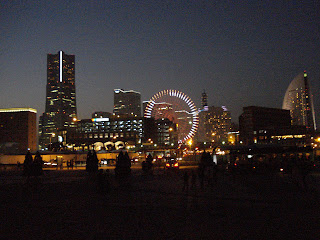 Yokohama at night, probably downtown.
 Koki and I at the gate to enter Yokohama's Chinatown.
 Koki and Kazue in Yokohama's Chintown.
 This was taken from Koki's apartment in Tokyo. If you look near the bottom middle-right of the photo you can see Mt. Fuji. The moon was also out at this time, and the weather was great.
 From Koki's apartment, taken by Koki.
 For New Year's we went to a local temple in the area of Tokyo where Koki and Kazue live called Nishiarai. We walked to this temple at about 12:30 am on New Year's Day, and it was bustling with people. Just walking from Koki's apartment to the temple I noticed a lot of people generally being 'out' to celebrate the holiday. I also noticed a lot of families together. Here I saw a lot of festival food and New Years' items being hawked. The line of people to our right in this photo are going to a shrine to toss a coin and say a prayer for the New Year.
 Another tradition in Japan is the ringing of these enormous bells with these enormous wooden sticks. I think at midnight they ring them a certain number of times signifying what year it is according to the Japanese calendar. Then, they open up the ringing to the public. I must say it felt really satisfying to ram this heavy stick against a giant bell and hear such a deep, full ringing sound. I hope someday to find out what it meant.
 From left to right: Hideki (Koki's brother), Koki and I in front of a mountain called Asama Mt., or Asama-yama, in Gunma prefecture.
 Asama -yama.
 Koki, me and Yoshi, who is Koki's sister's husband. It was pretty cold this day but the snow was pretty good for skiing and boarding (not too icy, with some powder towards the higher parts of the mountain). Also, I should mention that this area is really famous for its hot springs (onsen) where people come from all over to check out. At our hotel there was an outdoor onsen where the men would bathe separate from the women (and everyone was naked). It was really a neat experience to sit in the onsen at night with snow flurries and chilly winds coming down off the mountain. When I told my brother Matt about it he said "Yeah, there's nothing that rings in the New Year like sitting naked in the tub with a bunch of Japanese..." Don't push it pal.
 On the right is my Grandma's cousin, and Koki's father, Seiichan. He's holding Kentaro, his daughter Ikuyo's 14 month-old boy. On the left is Seiichan's wife, Kyomi.
 Me checking out Kentaro, his first time in the snow.
 Yoshi and Ikuyo (Seichan's daughter and Koki's sister) with their son Kentaro in front of the hotel we were staying.
 My Japanese relatives and I. From left to right, Seiichan, Kazue, Hideki, me, Kentaro and Kyomi, Ikuyo, Yoshi and Koki. I was happy to spend time with them this winter vacation.
 Tokyo from a tall building in Shinjuku, the area with Japan's federal buildings. When I arrived in Tokyo neither Koki, Kazue or I had planned anything to do from Christmas day to New Year's. So the day after Christmas, while Koki and Kazue had their final day of work, I traveled to this tall building (called Tocho) where they have a lot of tourism information on Tokyo. It was funny arriving in Tokyo and realizing it would be a good idea to look for worthwhile things to do the week I was there.
 Fish flags flying outside Tokyo Sea Life Aquarium, an awesome aquarium in an oceanside area called Kasai. The weather the entire week was really clear and a little windy, and much, much warmer than the winter vacation days I remember in Oregon.
 Kazue at Ueno Park Zoo. Koki, Kazue and I were really excited to see their pandas, but the big black and white one they had actually died a few months earlier. The only ones we saw were red and black ones, which were small and barely looked like bears. We were a little disappointed.
 A picture taken at Yoyogi park during a weekly flea market. This area of Tokyo was really neat to see because of all the hipsters and funny people that hang out there. Some of the people I saw reminded me of characters you would see at Venice Beach in Los Angeles. One guy was wearing a bright green joggers suit with reflectors all over him and some giant headphones as he cruised around the park on his bike...
 Koki and I taking a tour of the American and Japanese naval bases at Yokosuka, a famous port city in Yokohama Bay. The ships we saw were long and big (both the American and Japanese). This well know spot is the port where the American Commodore Perry came in the 19th century with big black battleships to essentially force Japan to open up to trade after having about 250 years of isolation. Oddly, I saw Perry's face sort of commemorated on the city's man-hole covers, as well as 'Instant Perry Curry' which you could buy as a souvenir.
 As a more personal anecdote, this is also the spot where my Japanese grandmother met my American grandfather, who had enlisted with the marines when they met in the 1950's.
 Yokohama city.
 Yokohama was really interesting to me in part because of all the Western style buildings and Christian churches we saw. This church is in an old area of town where there are primarily Western, older style houses and churches. I also liked Yokohama because it was very easy to walk around and see a great deal.
 Yokohama at night, probably downtown.
 Koki and I at the gate to enter Yokohama's Chinatown.
 Koki and Kazue in Yokohama's Chintown.
 This was taken from Koki's apartment in Tokyo. If you look near the bottom middle-right of the photo you can see Mt. Fuji. The moon was also out at this time, and the weather was great.
 From Koki's apartment, taken by Koki.
 For New Year's we went to a local temple in the area of Tokyo where Koki and Kazue live called Nishiarai. We walked to this temple at about 12:30 am on New Year's Day, and it was bustling with people. Just walking from Koki's apartment to the temple I noticed a lot of people generally being 'out' to celebrate the holiday. I also noticed a lot of families together. Here I saw a lot of festival food and New Years' items being hawked. The line of people to our right in this photo are going to a shrine to toss a coin and say a prayer for the New Year.
 Another tradition in Japan is the ringing of these enormous bells with these enormous wooden sticks. I think at midnight they ring them a certain number of times signifying what year it is according to the Japanese calendar. Then, they open up the ringing to the public. I must say it felt really satisfying to ram this heavy stick against a giant bell and hear such a deep, full ringing sound. I hope someday to find out what it meant.
 From left to right: Hideki (Koki's brother), Koki and I in front of a mountain called Asama Mt., or Asama-yama, in Gunma prefecture.
 Asama -yama.
 Koki, me and Yoshi, who is Koki's sister's husband. It was pretty cold this day but the snow was pretty good for skiing and boarding (not too icy, with some powder towards the higher parts of the mountain). Also, I should mention that this area is really famous for its hot springs (onsen) where people come from all over to check out. At our hotel there was an outdoor onsen where the men would bathe separate from the women (and everyone was naked). It was really a neat experience to sit in the onsen at night with snow flurries and chilly winds coming down off the mountain. When I told my brother Matt about it he said "Yeah, there's nothing that rings in the New Year like sitting naked in the tub with a bunch of Japanese..." Don't push it pal.
 On the right is my Grandma's cousin, and Koki's father, Seiichan. He's holding Kentaro, his daughter Ikuyo's 14 month-old boy. On the left is Seiichan's wife, Kyomi.
 Me checking out Kentaro, his first time in the snow.
 Yoshi and Ikuyo (Seichan's daughter and Koki's sister) with their son Kentaro in front of the hotel we were staying.
 My Japanese relatives and I. From left to right, Seiichan, Kazue, Hideki, me, Kentaro and Kyomi, Ikuyo, Yoshi and Koki. I was happy to spend time with them this winter vacation.
Tuesday, December 23, 2008
Christmas and New Year's in Japan
This Christmas and New Years I'll be spending time with some relatives in and near Tokyo. My grandmother's cousin's son and wife (Koki and Kazue, who took me to Mt. Aso earlier this year) will be having me over to their place in Tokyo on Christmas day and for a few days after. Then, the 3 of us will go to Koki's father's house in Saitama prefecture, about an hour and a half by train from where Koki and Kazue live in Tokyo. At Koki's dad's house, I will be able to see a few other relatives as well. On New Year's Day we will visit a famous shrine in Tokyo. And somewhere in these 10 days of vacation I have, my relatives and I will travel together to a ski resort - where I am lucky enough to go snowboarding on a mountain in Japan! This is the first winter vacation I have spent away from my immediate family (the Meuse 5). But, this is also the first time anyone in my family has spent these holidays with our Japanese relatives. I am happy to be keeping our family connection going, but I am more immediately excited to eat lots of their food, get to know them better, and check out New Year's in Japan. I've heard it's the biggest holiday celebrated in Japan.
Christmas, however, is a different story. Though I've seen lots of Christmas decorations hung up in department stores (which I spotted even before Thanksgiving!) - and it's hard to walk into any store lately and not hear Christmas music, or flip on the TV and not see some sort of ad with a Christmas jingle, I've seen very little religious connection to the holiday. I asked one of my co-teachers if Japanese people celebrated Christmas, and he told me that on December 24th families and couples get together to have food and drinks. Also, one of my new friends here, who has spent 3+ previous years living in Japan, told me that Christmas here is more like a couples' holiday, while New Year's is more about family time. And, I've asked students a few times now during a warm-up activity, "What date is Christmas?" - and more often than not I've gotten the answer "December 24th." I understand that to expect a largely non-Christian nation to be celebrating a traditional Christian holiday wouldn't make much sense, but it's funny to me to see so many Christmas decorations and hear so many Christmas songs (including ones sung by students) while the true meaning behind the holiday seems to go largely unnoticed. Though I can't speak for all of Japan, and I'm sure there really are lots of Japanese people do celebrate Christmas as a Christian holiday, I think this generalization more or less holds true for most of Japan.
Well I wish everyone reading this a Merry, Merry Christmas, and a Happy, Happy New Year. And for all who are enjoying plenty of holiday sweets, I leave you with this picture, taken at the local "Trial Supercenter..."
 Asparagus Biscuits anyone?
Christmas, however, is a different story. Though I've seen lots of Christmas decorations hung up in department stores (which I spotted even before Thanksgiving!) - and it's hard to walk into any store lately and not hear Christmas music, or flip on the TV and not see some sort of ad with a Christmas jingle, I've seen very little religious connection to the holiday. I asked one of my co-teachers if Japanese people celebrated Christmas, and he told me that on December 24th families and couples get together to have food and drinks. Also, one of my new friends here, who has spent 3+ previous years living in Japan, told me that Christmas here is more like a couples' holiday, while New Year's is more about family time. And, I've asked students a few times now during a warm-up activity, "What date is Christmas?" - and more often than not I've gotten the answer "December 24th." I understand that to expect a largely non-Christian nation to be celebrating a traditional Christian holiday wouldn't make much sense, but it's funny to me to see so many Christmas decorations and hear so many Christmas songs (including ones sung by students) while the true meaning behind the holiday seems to go largely unnoticed. Though I can't speak for all of Japan, and I'm sure there really are lots of Japanese people do celebrate Christmas as a Christian holiday, I think this generalization more or less holds true for most of Japan.
Well I wish everyone reading this a Merry, Merry Christmas, and a Happy, Happy New Year. And for all who are enjoying plenty of holiday sweets, I leave you with this picture, taken at the local "Trial Supercenter..."
 Asparagus Biscuits anyone?
Tuesday, December 16, 2008
Back at Shonai Chuu
I feel like I've been through a lot this last week and a half. Today I played some basketball with a few of the older boys from Shonai after having school lunch. I've been playing with these guys pretty regularly now in my short time (3 and a half weeks total) at Shonai Chuu. On the court I couldn't be happier - having a nice pick-up game, usually with fair teams and pretty upbeat and polite dudes. Off the court, in the classroom, is a whole different situation. It's not that I've been the direct target of disrespect. In a way I actually feel respected by these kids because they're willing to listen to me in a way they don't with their regular English teacher, and they are almost always friendly with me.
What really bothers me is that they are allowed to do things in the classroom that are beyond what I consider near to acceptable but are considered a part of everyday life at Shonai Chuu. I can see that when clumps of kids are chatting and not listening to my "American English pronounciation" of a few words - this may not be so bad. But it seems these kids are being brought up to think that it's ok to talk while the teacher is. Or to bring a stray dog into the classroom (this happened yesterday). Or to eat their lunch before everyone else begins eating (a huge cultural no-no). Or to tackle and write on each others' faces with big black pens (I was with one of the English teachers when this happened, and she barely looked up as we walked past these 2 kids). Or to go to the bathroom using urinals that don't have water running in them (this bathroom is also the one the men teachers use, and it really reeks and needs cleaning...its the worst place I can think of at that school). Or to grow up learning to pronounce the word "were" like "waar" because their teacher teaches them that its proper English. Or to hit each other during class and bully one another (one student was punching another student kind of hard in the kidneys, to a point where I felt the need to get in his face to stop him from continuing).
I don't mean to dwell on the negative here...because there really is a lot of good I can say about these kids, their teachers, and the school. I'm just complaining to feel a little better and to give everyone a small sense of what I've been going through lately. Last week was a lot more difficult than this one, and 2 grades of students will be watching "Shrek" tomorrow, so maybe I won't feel like I have to be on high alert like its been so often (to be fair, this 'being on guard' feeling only applies when I've been working with the 2nd and 3rd graders (14-15 year olds) - the 1st graders (+/-13 year olds) have been really awesome to work with). Also, I'm finished working at Shonai on Friday, so I have only three more days there for a while. And, one of their English teachers is leaving on Friday as well, so when I come back I'll be working with a new teacher. Things might be better when I come back...
What really bothers me is that they are allowed to do things in the classroom that are beyond what I consider near to acceptable but are considered a part of everyday life at Shonai Chuu. I can see that when clumps of kids are chatting and not listening to my "American English pronounciation" of a few words - this may not be so bad. But it seems these kids are being brought up to think that it's ok to talk while the teacher is. Or to bring a stray dog into the classroom (this happened yesterday). Or to eat their lunch before everyone else begins eating (a huge cultural no-no). Or to tackle and write on each others' faces with big black pens (I was with one of the English teachers when this happened, and she barely looked up as we walked past these 2 kids). Or to go to the bathroom using urinals that don't have water running in them (this bathroom is also the one the men teachers use, and it really reeks and needs cleaning...its the worst place I can think of at that school). Or to grow up learning to pronounce the word "were" like "waar" because their teacher teaches them that its proper English. Or to hit each other during class and bully one another (one student was punching another student kind of hard in the kidneys, to a point where I felt the need to get in his face to stop him from continuing).
I don't mean to dwell on the negative here...because there really is a lot of good I can say about these kids, their teachers, and the school. I'm just complaining to feel a little better and to give everyone a small sense of what I've been going through lately. Last week was a lot more difficult than this one, and 2 grades of students will be watching "Shrek" tomorrow, so maybe I won't feel like I have to be on high alert like its been so often (to be fair, this 'being on guard' feeling only applies when I've been working with the 2nd and 3rd graders (14-15 year olds) - the 1st graders (+/-13 year olds) have been really awesome to work with). Also, I'm finished working at Shonai on Friday, so I have only three more days there for a while. And, one of their English teachers is leaving on Friday as well, so when I come back I'll be working with a new teacher. Things might be better when I come back...
Subscribe to:
Posts (Atom)